Deep Coverage
Filings are the origination point of all financial information , we cut straight to the source with our ingestion and processing across many exchanges. We process 1500+ types of filings whole .
Ask Archivist a question, get answers grounded in exchange filings all over the world.
CoverageLast Updated: …
… Symbols… Filings
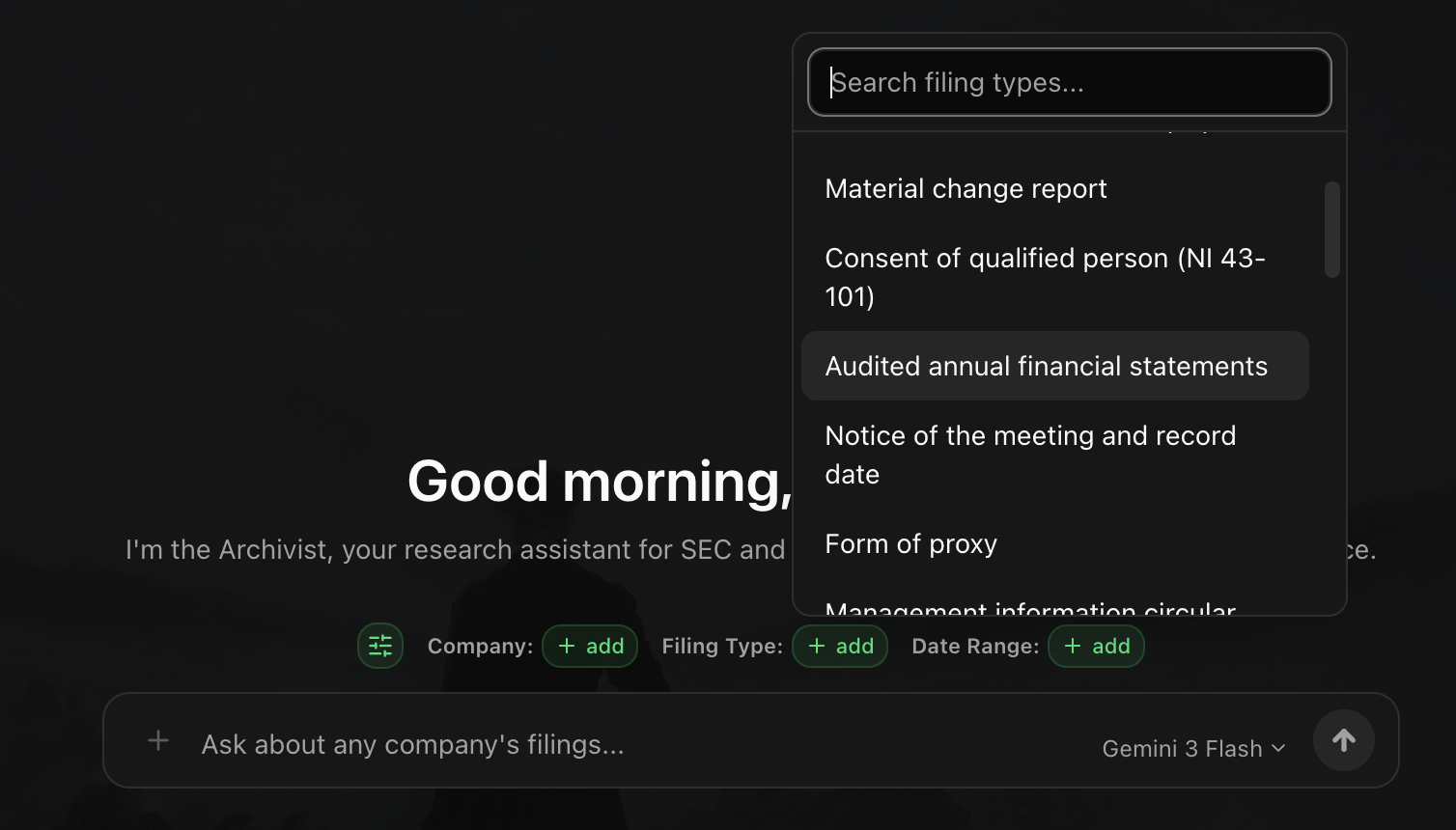
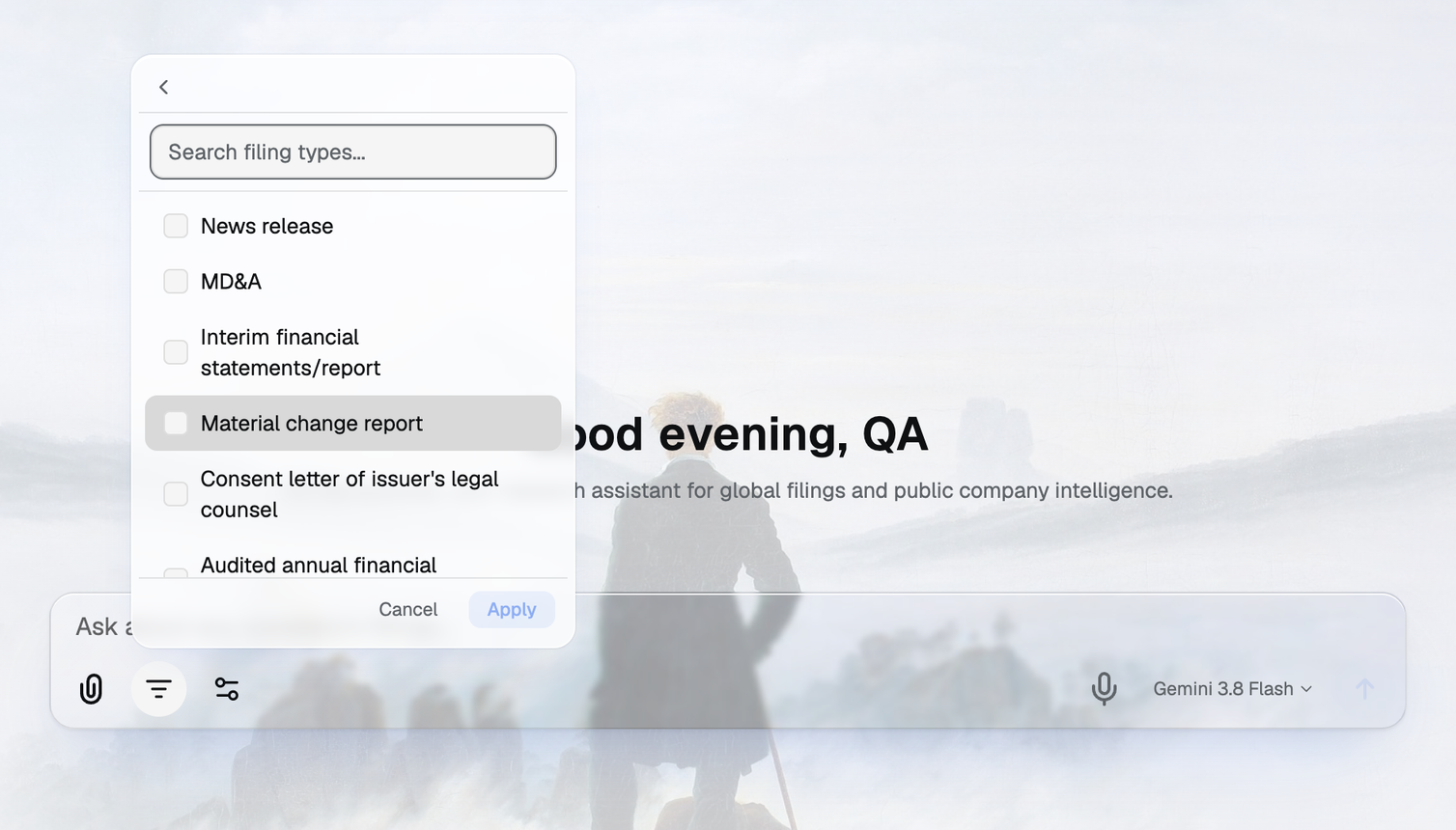
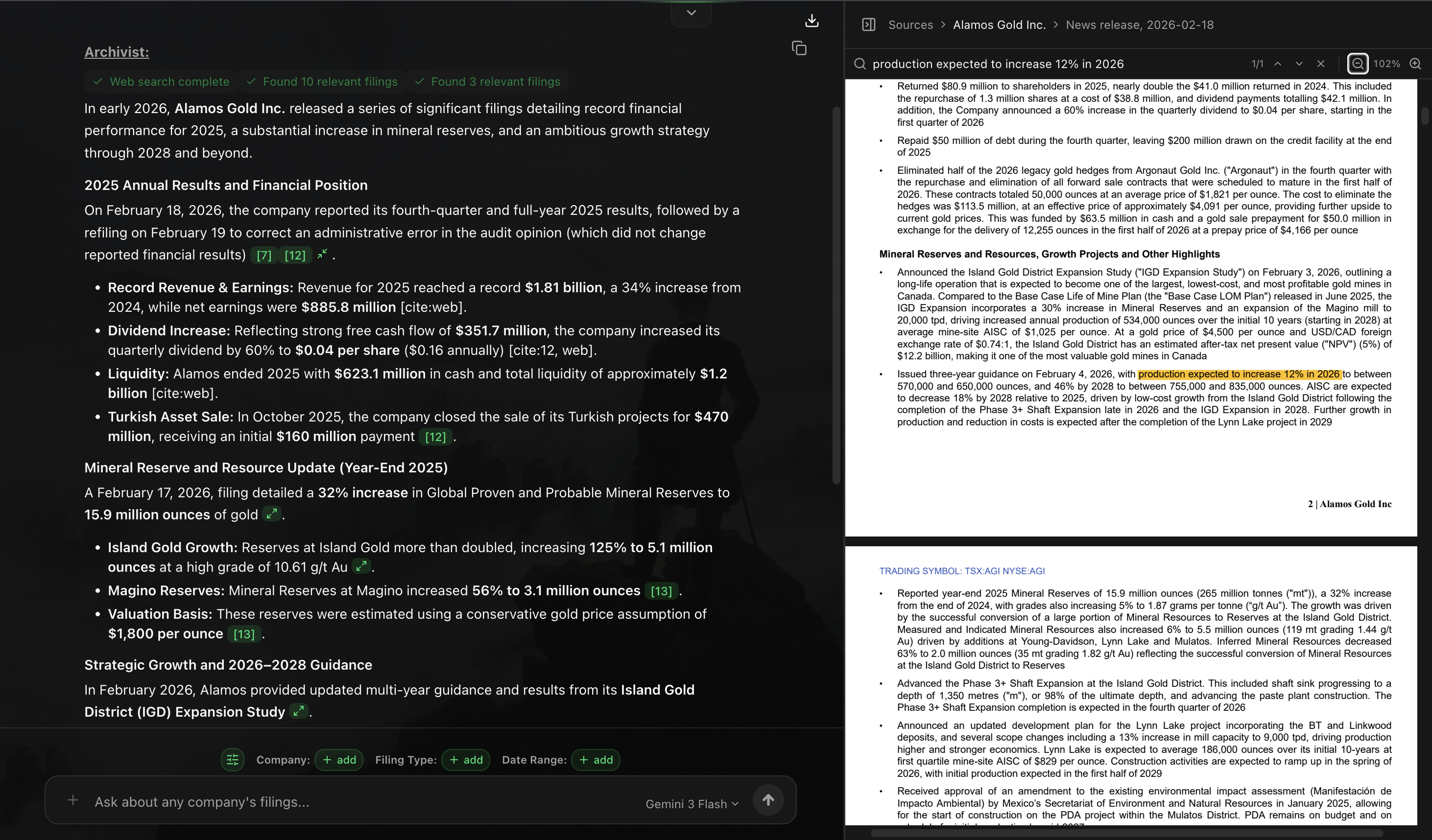
Type a question about any public company in natural language. Add filters to your desire or not, Archivist will figure it out.
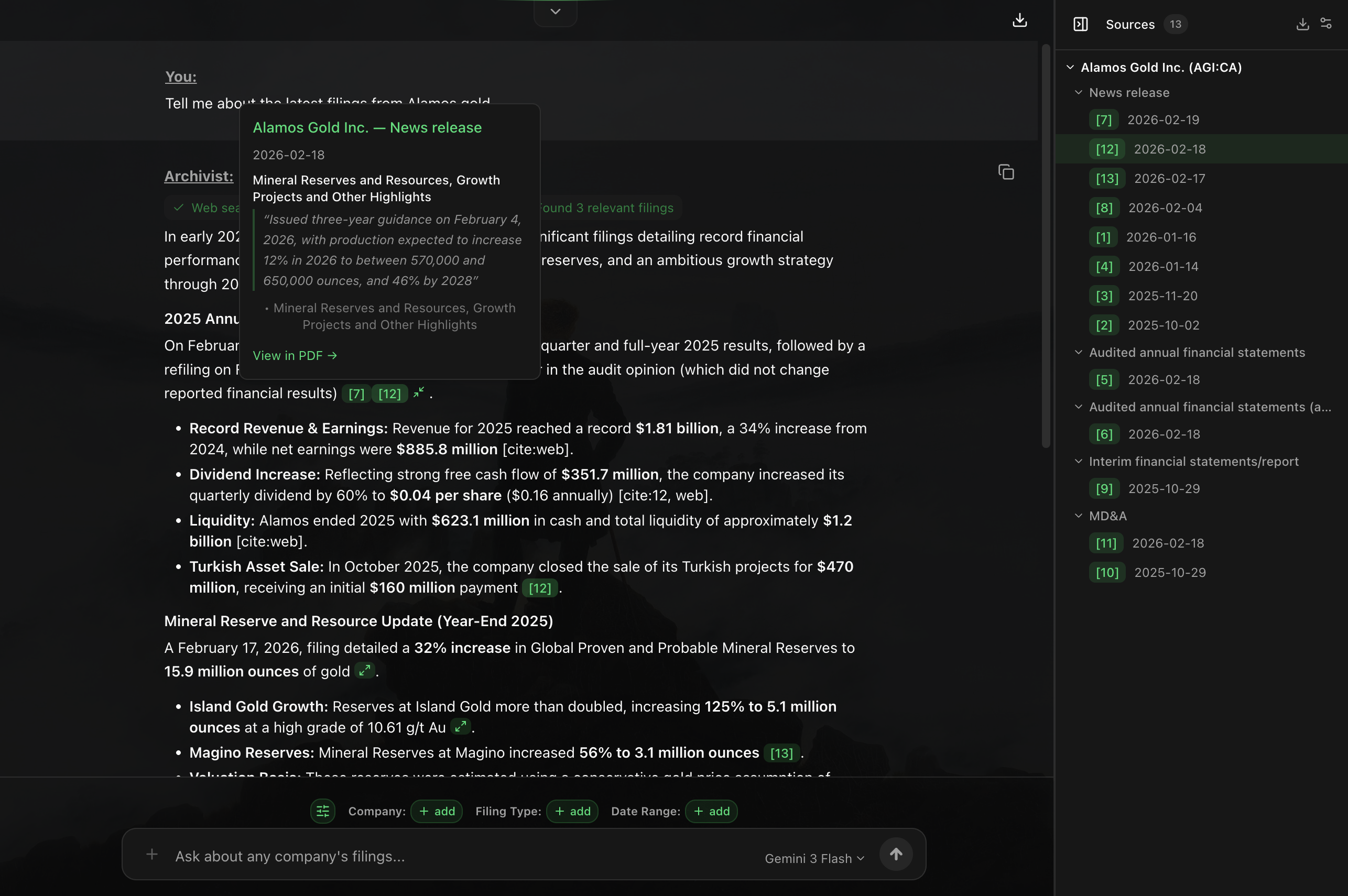
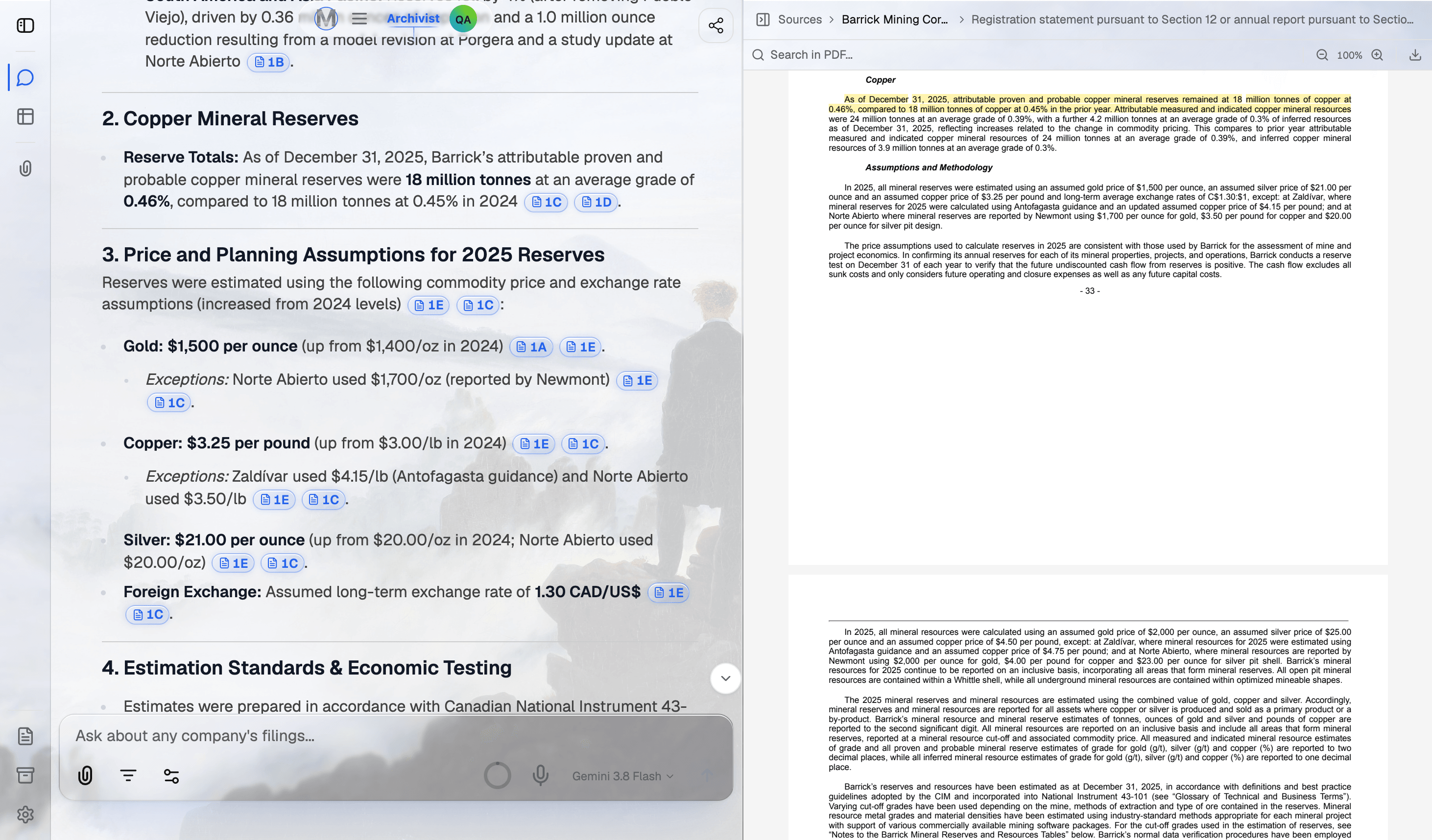
Every answer comes with citation badges linked to the exact source. Hover any badge to preview the passage, click to open the filing.
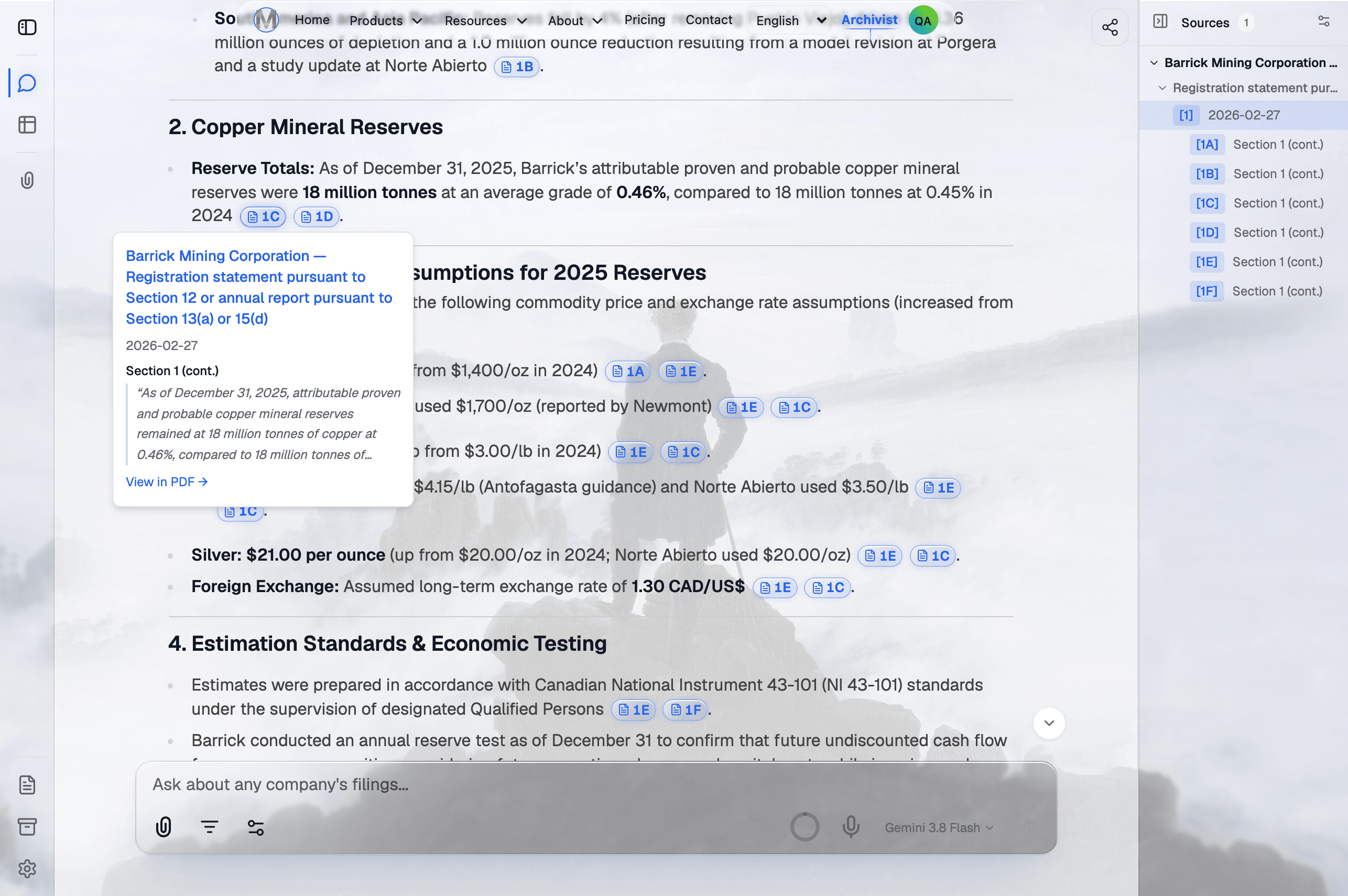
Click any citation to open the original filing. The PDF viewer highlights the exact section so you can verify every claim against the source document.
There is more to it for you to discover. Get started on Forever Free, with your first 10 answers on us.
We beat the native tooling of the AIs we integrate with on both provenance and efficiency in financial research.
Filings are the origination point of all financial information , we cut straight to the source with our ingestion and processing across many exchanges. We process 1500+ types of filings whole .
We shine when the answer is specific and buried: a covenant in a footnote, a metric few vendors extract. To achieve our edge we use every trick in the book plus some of our own in our indexing and search algorithms.
Archivist reads the original filings themselves. Every statement links to its passage, and one click opens the filing beside your answer, scrolled there and highlighted. Just want the relevant text? Hover a citation to read the passage without opening anything. [6]
Every answer is checked against both the filings and the web, and we keep what holds up. You always see exactly how far the evidence goes.
Research in the browser, or bring Archivist CLI / MCP into Claude Code, Codex and any agent you already use. Chat, grids across many companies and cited passages work the same everywhere, and every run is saved to your account for review.
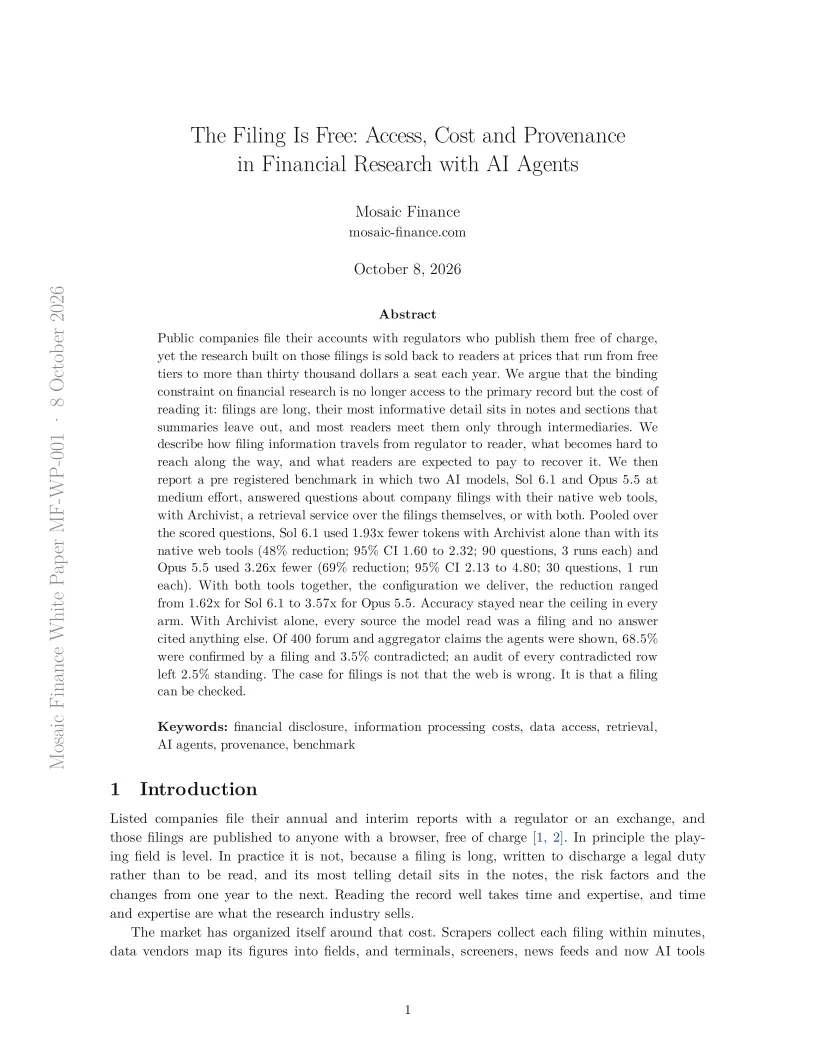
White paper
Mosaic Finance. October 8, 2026. 17 pages, in English.
The Mosaic MCP/CLI plan is USD 8 a month with a 30 day free trial that covers the usage required. Bring your own Claude or ChatGPT plan, take the sample questions from the repository and swap in your own.
Opus 5.5
Sol 6.1
Opus 5.5
Sol 6.1
Native web tools got the facts right too, but spent more tokens getting there and leaned on secondary sources: 28.5% of Sol 6.1's and 23.0% of Opus 5.5's factual claims cited something other than the filing, and most claims labelled secondary matched or cited company websites.
Opus 5.5 (Claude Code 2.1.289), 5 questions per type x 1 run
| Question type | Tokens consumed per question | ||
|---|---|---|---|
| Native AI web tools | Archivist alone | Both (web tools and Archivist) | |
| Lookup: 1 to 3 facts from one filing | 74,245 | 29,290 (61% reduction / 2.53x less) | 24,175 (67% reduction / 3.07x less) |
| Multi hop within one filing | 439,856 | 49,193 (89% reduction / 8.94x less) | 61,356 (86% reduction / 7.17x less) |
| Several filings of one company | 157,965 | 39,330 (75% reduction / 4.02x less) | 40,609 (74% reduction / 3.89x less) |
| One metric across 5 to 10 filings | 333,619 | 125,283 (62% reduction / 2.66x less) | 102,617 (69% reduction / 3.25x less) |
| Breadth: the same fact across 7 to 10 companies | 510,694 | 97,058 (81% reduction / 5.26x less) | 103,917 (80% reduction / 4.91x less) |
| Reach: one company across 20 to 26 filings | 387,797 | 244,272 (37% reduction / 1.59x less) | 200,156 (48% reduction / 1.94x less) |
Sol 6.1 (Codex CLI 0.160.0), 15 questions per type x 3 runs
| Question type | Tokens consumed per question | ||
|---|---|---|---|
| Native AI web tools | Archivist alone | Both (web tools and Archivist) | |
| Lookup: 1 to 3 facts from one filing | 63,928 | 82,067 (28% increase / 1.28x more) | 73,822 (15% increase / 1.15x more) |
| Multi hop within one filing | 157,191 | 88,387 (44% reduction / 1.78x less) | 104,432 (34% reduction / 1.51x less) |
| Several filings of one company | 109,105 | 88,918 (19% reduction / 1.23x less) | 119,330 (9% increase / 1.09x more) |
| One metric across 5 to 10 filings | 225,155 | 184,633 (18% reduction / 1.22x less) | 218,214 (3% reduction / 1.03x less) |
| Breadth: the same fact across 7 to 10 companies | 598,310 | 207,516 (65% reduction / 2.88x less) | 264,723 (56% reduction / 2.26x less) |
| Reach: one company across 20 to 26 filings | 662,303 | 287,218 (57% reduction / 2.31x less) | 340,464 (49% reduction / 1.95x less) |
Our story
We are a team with experience across a wide array of fields, from deal making and corporate finance to mining, energy, law and cybersecurity. All of it taught us the same thing: the market is loud with noise and opinion, while the facts sit quietly elsewhere.
Accuracy comes down to how many eyeballs get to check the work, so we put yours on every answer. Each one cites its source and takes you to the exact passage.
The companies we followed, with different motivations and questions, across different geographies and languages, required a better search tool that nothing quite answered. So we built the thing we wanted.


 The Mosaic Finance teamFounders of ArchivistMore about us
We talk about what we're building in our blog. Transparency is the product.


A comprehensive overview of common AI misconceptions and the factual realities that should guide engineering decisions.


The math on autonomous agents is brutal. Chain 10 steps at 95% accuracy each and your total success rate is 60%. The hype ignores exponential decay.


If your system breaks because you changed an adjective, the problem isn't your prompt; it's your architecture. The mature approach is System Engineering.


Fine-tuning is effective for teaching form but terrible for injecting facts. The 'domain-specific fine-tuned model' pitch is mostly marketing.


Million-token context windows sound impressive. The reality: models struggle to retrieve information buried in the middle of long prompts.


The 'blackbox' narrative is convenient but wrong. AI models are sequences of math operations. Control the arithmetic, control the output.


LLMs predict the next token. That's it. They've mastered linguistic form without possessing communicative intent.


If code can do it, code should do it. There's a concerning number of AI automations that shouldn't be AI automations.


The industry conflates 'bigger' with 'better.' This ignores basic math. Running a cheaper model multiple times beats expensive single passes.
A comprehensive overview of common AI misconceptions and the factual realities that should guide engineering decisions.
The math on autonomous agents is brutal. Chain 10 steps at 95% accuracy each and your total success rate is 60%. The hype ignores exponential decay.
If your system breaks because you changed an adjective, the problem isn't your prompt; it's your architecture. The mature approach is System Engineering.
Fine-tuning is effective for teaching form but terrible for injecting facts. The 'domain-specific fine-tuned model' pitch is mostly marketing.
Million-token context windows sound impressive. The reality: models struggle to retrieve information buried in the middle of long prompts.
The 'blackbox' narrative is convenient but wrong. AI models are sequences of math operations. Control the arithmetic, control the output.
LLMs predict the next token. That's it. They've mastered linguistic form without possessing communicative intent.
If code can do it, code should do it. There's a concerning number of AI automations that shouldn't be AI automations.
The industry conflates 'bigger' with 'better.' This ignores basic math. Running a cheaper model multiple times beats expensive single passes.